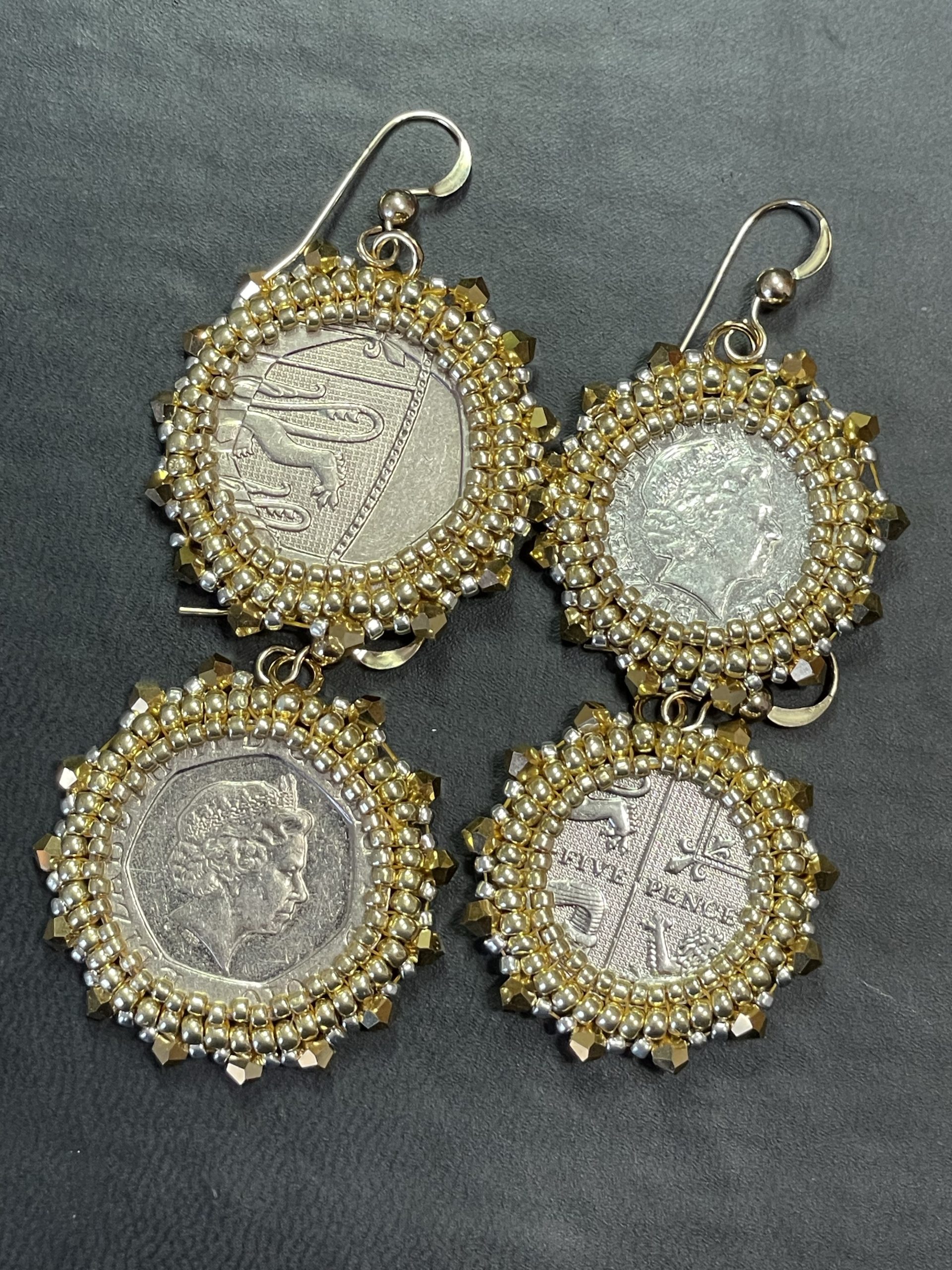
A month or so ago (or more?), Sylvia gave me a bead crochet necklace, and I started working on a necklace for her in return. I love the necklace she made for me — it’s matte transparent s/l red, black, and supra white in an interesting geometric pattern. Sylvia likes turquoise, among other colors, so I sent her pictures of bead combinations, pictures of 3 samples, and we decided on the combination below.

For a clasp, I used a magnetic clasp. I somehow have gotten this far without using one — it was amusing; it stuck to the needle, it stuck to the scissors…

The necklace has a lovely feel to it. I have yet to make one of this stitch for myself; they’ve been gifts. Maybe next time? I sent her these pictures, she likes it, so it’s on its way.

I still have my loom sitting here. I am thinking I may need to redo the footers, the spacing is too narrow for the width of the individual beads (2 rows of beads on the loom). I just don’t want to face redoing it. I think I need to loom one row of beads to get the spacing right (to take out later), then the footer, and then the pieces.

I have a bead book checked out from the library that is due in a few days, and I cannot renew it as it has a waiting list. I want to try one project out of that, with modifications, of course.

I have more beads I want to cover with right angle weave.

I want to make a couple more rings, like my blue ring. I have a jasper cab and a dichroic cab waiting here with their accompanying beads.

I have a Jo Woods kit to complete sometime in the not-so-distant future too.

First, I have to pick up the detritus that is on my work table from the ring, this bracelet, and other color ideas. Then, I will probably start the one out of the library book. Start something new rather than finish something unfinished, how typical is that?

Share/Save/Bookmark

Tags:

Last week, I wrote about session 1, with Dr. Patricia Briggs, from the Minneapolis College of Art and Design. It was about expressionism, abstractionism, the progression towards minimalism. This session, she continued to move forward in time to help us understand contemporary art. I took many more notes. Again, all mistakes below are mine.

Dr. Briggs started with putting forth Donald Judd as a great example of minimalism. His work shows the minimalist view that art is about expression, not self-expression. It’s a radical outside of human-ness. She again talked about Duchamp, where his art was not of the artist’s touch and hand. She gave the example of in his welded pieces, he gave a welder instruction on construction.

She referenced again action painting like Pollock and Gutai, where painting is about a trace of performance. This happened at about the same time as performance art got big. At the Walker, there are some Yves Klein body prints — naked female torsos printed onto paper. This is art that is an outcome of an activity.

Now, the aesthetic and anti-aesthetic tradition have been opposing each other in the 20th century. The anti-aesthetic tradition is Dada, conceptualism, sometimes surrealism (which can have a foot in both camps). Dada is the anti-art, that the beauty shown, if any, is convulsive beauty, the beauty of the abject, decay, beauty that hurts. Dada includes making collages as art — something common now, but not then. Making art of trash (found objects/modified found objects), art that goes out to the masses using low art, popular art such as mass media, photography. The function is to uncover those things that you usually don’t think about.

Dr. Briggs talked about Raushenberg, who was influenced by Duchamp — and Merce Cunningham (dance choreographer who felt that dance should be more real than artificial ballet) and John Cage (a pianist who would sit at a piano and let the sound of the audience be the piece). Raushenberg painted a field of white, and the shadow you cast over the piece became part of it. And if it got dirty, an assistant repainted it. Rauschenberg had a piece that was erasing a piece of art that de Kooning drew. She said it took him weeks to erase, that this was a collaboration between the artists, and that de Kooning drew something that would be hard to erase. He progresses to assemblages (vs. collages); her example was Bed, made up of his quilt and pillow, altered. The canvas is a flat tabletop, you put stuff on it, and the viewer processes it.

Neo-Dada uses expressionist paintbrush strokes, sometimes puts it next to collages, found objects, junk. These expressionist paintbrush strokes are ironic, not expressionist. Warhol was next on the neo-Dada agenda, about his appropriation of images to create art of the world. She talked about his Marilyn Monroe images — they’re not about Marilyn, they’re about how the Hollywood machine makes puppets out of people, objectifying people. Dr. Briggs said what’s brilliant about Warhol is that we like to look at it, unlike many other Dada and neo-Dada artists.

Using multiple texts is very post-modern. There’s no difference between high art and advertising. Multiple objects are pulled together, not necessarily to make a narrative. Many post-modern artists appropriate images from many contexts. Sherrie Levine is the apex of this, where she literally photographs other photographs, other paintings, and puts her name on it. This is commentary on originality (there is nothing new under the sun), authority of ownership, a very post-modern thought. To post-modern artists, the author is dead, all speaking is quotation, you can’t own an idea. Other issues explored by post-modern artists is exploration of the body, and not pretty poses. It’s a shift to art that doesn’t show the human body as a beautiful aesthetic, but physically clumsy things with vulnerabilities and openings. Racial identity is another theme explored, art about people who don’t have a voice.

At the Walker (the location of the next and last session), there is a lot of minimalism. This is not where you go to find craft, beauty, to find something that makes you feel good. Dr. Briggs is going to show us some of her favorite works. I’ll let you know what they are….

Session 3

Share/Save/Bookmark

Tags: , , , ,

I wear a lot of blue, but don’t have any blue rings. Today, I remedied that. The stone is an inexpensive lapis cab, 14×10mm. The opaque blue is a French size 13 bead, with s/l blue Japanese 15s and white pearl charlottes as accents. The bezel is made with stack stitch, gives a nice smooth edge to the bezel that peyote doesn’t. The band is herringbone. I started in the middle of the back, and added rows to each side to get the desired size. I used a variation at the end of the rows so that no thread is on the outside of the beads. Now, I have a blue ring!

Share/Save/Bookmark

Tags: ,

Okay, here’s more that I’ve added to my feed reader, and I’ve remembered to add them to this blogroll too. Just in case you want to browse….

The lovely thing about having so many beady blogs to read is that there’s always something new — somewhere!

Share/Save/Bookmark

Tags:

Tonight, I attended the first of 3 sessions taught by Patricia Briggs, PhD, Associate Professor of Liberal Arts at the Minneapolis College of Art and Design. The subtitle of the series is “Understanding contemporary art.”

I have no art history background, no art education. Dr. Briggs gives an enjoyable, accessible lecture, and I learned a great deal. Any errors below are mine.

She started with a discussion of the history of the Walker Art Museum, which will be the location of the last meeting (she trains docents for the Walker). It was a private collection in a home, then established in 1927 as the first public art gallery in the Upper Midwest. In 1944, a new building and a new focus came together in the wake of MoMA, to recreate the Walker as a museum of modern art. An addition in 2005 adds an architecturally postmodern wing to the modern building.

Dr. Briggs started with a discussion of the function of art. Before literacy, it was propaganda for the church and state. At the rise of the merchant class in the 17th century, different types of art emerged — landscapes, still lifes.

In the late 19th century, art moved away from narrative to art that is doing something else — expressive, abstraction; to colors and lines that don’t mimic nature. Think the brush strokes and colors of Van Gogh. These serve to suggest something, or make you feel something.

On to the early 20th century came the rise of conceptual and philosophical exploration such as Duchamp or Magritte. Think surrealism or Dada. Why is the picture and word of a pipe, a pipe? How do we know that words and signs make meaning? These conceptualists were creating a new audience for art, not entertaining, but art that was meant to make you think. The expressionists and abstractionists were one group at this time, and these conceptualists were in another.

Dr. Briggs said that Duchamp was the most important artist of the 20th century, that in the Dada shadow of WWI, he thumbed his nose at art as bourgeois, that art should be political or shocking, and incite people to think, to challenge them. Art is transforming meaning. He was the beginning of post-modernism, bringing life and art together. Duchamp spoke to a different audience; art of the formalist abstract expressionist tradition viewed art and life as separate, not for politics, not for commerce, not dirtied by life.

The Modern view is that arts’ function is to produce discourse, dialog, discussion of ideas and feelings.

Dr. Briggs went on to discuss abstractionism, usually associated with expressionism, often thought to be the natural progression of art. She showed us examples of paintings by various artists such as Gauguin, Van Gogh, where the paintings became flatter (less depth of field). She described expressionism as a way of painting, where color, shapes, and forms were more important than the subject matter. The progression was away from naturalism towards abstractionism.

She termed Kandinsky as a different type of Expressionist, a major shift to just abstract forms with no narrative. This is art that is meant to speak to emotions, like music it is intended to wash over you. Pure abstraction, no form.

In the 1920’s, Mondrian had a philosophical outlook, that if you surrounded people by soothing, calming art, we’d be a better people and a better world. Art should produce an effect.

Her example of pure abstraction was Hans Hoffman. Hans Hoffman! His work is what I loomed here. Now I know a bit more about him, more than what I read in the Smithsonian blog entry that interested me in his work. Dr. Briggs had a high school art teacher that introduced her to Hans Hoffman. Her description of his work is “form is plastic.” There is push and pull, blurry vs hard edges. Shapes and forms are supposed to dance in front of you, enliven, be plastic. She finds every one of his works “exciting.”

She went on to talk about Color Field painters, those painters who make monstrous, mural-sized paintings of one (or very few) colors. Big blocks of colors. These are meant to create an environment for you. You place yourself in front of one of these big paintings, and it can take you somewhere.

Okay, so if the progression of painting is towards flat monochrome paintings, is painting dead? Are we done? Now, we’re on to Minimalism, a new direction. There is no intended connection with spirit, or emotion. It is painting as an object, not a metaphor for anything. This is form as pure object. Ad Reinhardt was one of her examples of this — he painted black canvas after black canvas. A painting is a painting. That’s it.

Minimalism makes us self-conscious, it doesn’t say anything, it’s just a thing. It talks about the space you’re in, calls to us in a different physical way. These massive minimalist paintings or sculptures? They are intended to be the only thing in the room. There is no evidence of the artist’s hand. This is conceptual art.

Another progression was to formal abstraction. This can be like performance art, a record of the moving body — i.e., Pollock. Art and life together. Art as a stage for the moving body.

And, that was the end of this session. I’m an exuberant note taker. Can you tell?! I’ll write more next week, after the next session.

Session 2

Session 3

Share/Save/Bookmark

Tags: , , , ,

« Older entries § Newer entries »