Artists

You are currently browsing the archive for the Artists category.

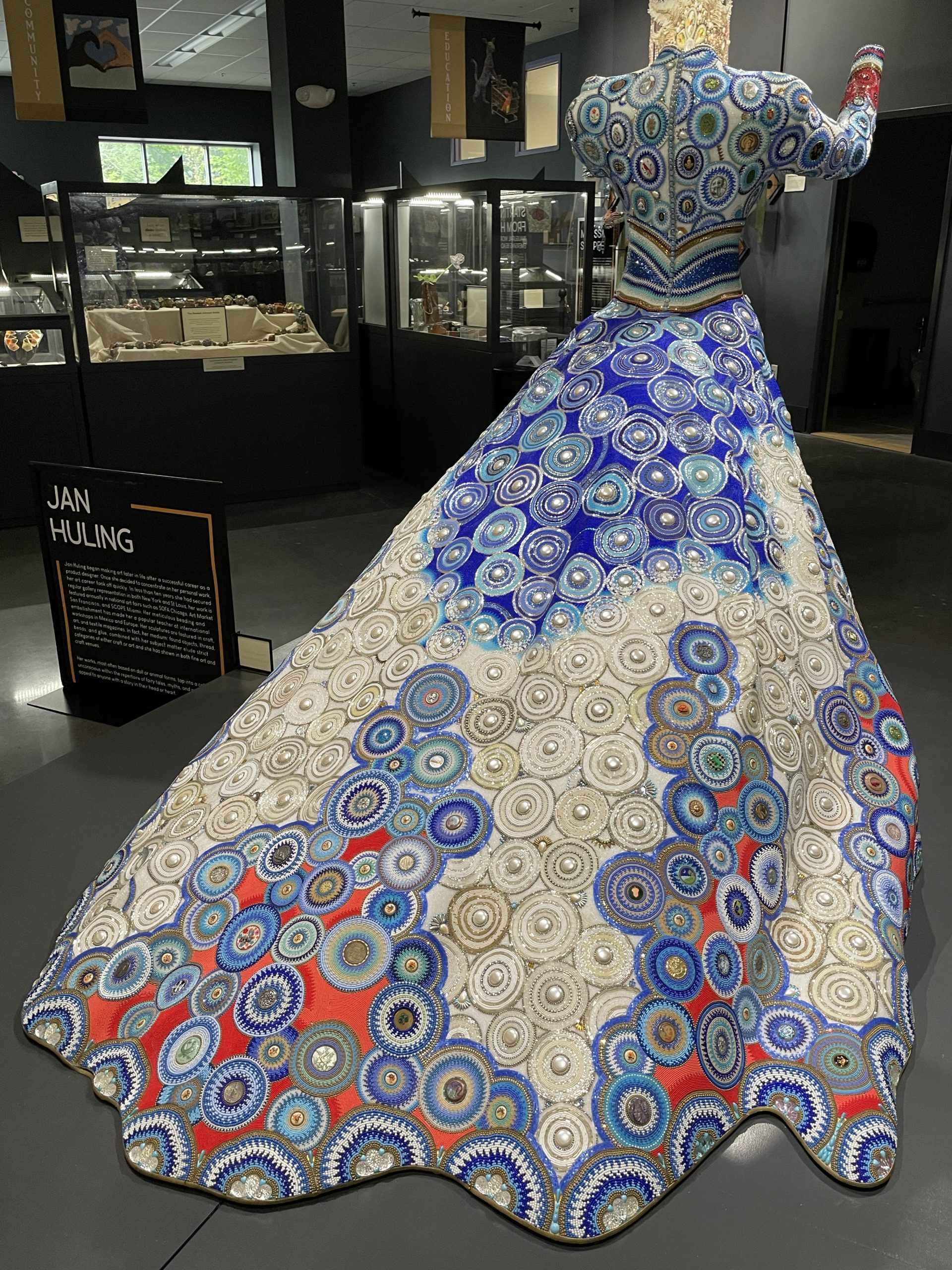
I looked at a copy of American Style magazine today, and listed on the cover is “Craft Collaborators Jack and Linda Fifield.” I thought the names looked familiar, turned to the article — and yes, they should be familiar, I have her name on my links page of my website. They are both woodturners, and she is a beader in addition, adding beadwork to turned vessels. The description in the article of her beadwork was written by someone who doesn’t bead, “She threads tiny Czech glass beads onto nylon filaments that cross, making a net to encase a form.” It’s peyote, beautifully done.

A current project that she’s working on is a vessel Jack turned, 4 FEET tall, “the whopper.” Linda has been working on it a year, and is one-third done.

The entire article is online! Not all the pictures are, but a picture of my favorite vessel included tops the article. Also check out their website.

Share/Save/Bookmark

Tags: ,

In session 1 and session 2 of this series on contemporary art, taught by Dr. Patricia Briggs, from the Minneapolis College of Art and Design, we met in a library, and she showed us slides and talked about the progression of contemporary art. For this last session, we met at the Walker Art Center for a tour of selected pieces. Dr. Briggs said she was going to show us her favorite pieces; we had an hour, saw a lot, and only touched the surface of the museum.

The galleries that we visited are organized sequentially, earlier styles first. The first piece she showed us was a Hans Hoffman, which I had admired before, but not retained the artist’s name — I loomed a different piece of his. She again said that he was a mature artist at his best, an abstract expressionist. His shapes show relationship, foreground, background, are sculptural, alive, and not flat; exciting and dynamic paintings about painting.

Clifford Still was next, another abstract expressionist, this piece was darker, more gothic, but also about shape and color and pure painting.

Then Rothko, another pure painter. He uses a couple of tones, careful brushstrokes. There’s a hazy fuzziness, an ephemeral quality, floating shapes, hovering, misty — representing the unrepresentable.

The next room was Alternative Modernism, the action, performance paintings. Not about controlled reason in the previous room, not about discipline. The first painting here was by Shirago Kazuo. He painted with his foot?!

Then an explosive poured painting by Herman Nitsch, done on burlap.

Progressing to the next gallery, there was a piece in the center of the floor called Direction. It’s an elongated triangle of granite, smooth, but not polished. A small compass is on the top near the wide end — north does not match with the pointing of the arrow of the granite. It speaks of nature, the primitiveness of the sedentary rock (layers visible on the edges), found objects (compass), and is like poetry, showing space, direction, and time.

End of painting pieces were in the next room. There is a white canvas with a vertical slash. A white canvas torn in the middle. Paintings as objects.

The next gallery has a piece by Yves Klein. There’s a shallow pool that’s bright blue on the inside, and then blue body prints of nude women on the paper on the wall. At the opening, he had the blue pool and blank paper on the wall. His models created the prints at the opening.

There is a cabinet of Fluxus artists, something she didn’t cover in the other two sessions. This is ephemeral art, seeing beauty in the world around you, noticing small things, art to the people, not in museums, art you participate in. Things like mail art. One was a postcard, and the writing on it is something like, “Your thumb on the side of this card is the realization of my intention.” Another is a small plastic container, like a film canister, with a bean in it. It is labelled, “Empty out the bean, put the cylinder to your ear. Listen to the sea.”

We stopped next at a painting by Chris Ofil, a contemporary artist. He’s African American, and went to Africa and came back inspired — and with elephant dung. The painting is rich, bright colors, with a lot of black contrasts, geometric and psychedelic patterns, small photographs of faces, speaking to hip hop culture, language of the street. There are rows of small dots — Dr. Briggs said it looked like beadwork. Beadwork! In the center of the painting is a piece of elephant dung with an eye painted on it. Instead of hanging on the wall, the painting is resting against the wall, on feet of elephant dung.

Dr. Briggs stopped next at a piece by Richard Prince, this pure, flat, gray painting, with a shape at the top. There is currently an exhibit by him on display at the Walker, that we didn’t have time to see. He’s known as doing art incorporating the Marlboro Man, masculine art. She said she understands and likes this piece more now, after having seen the exhibition. She said to think of the painting as half painting, half car — the shape looks like the hood of a car.

One of the stranger pieces is next. It’s a small child’s resin chair, sitting over a drain, with a box of facial tissue on the seat of the chair with a cover over the box with flowers on a black background. This is by Robert Gober, who makes a lot of things with drains in the them. It’s to make you wonder what’s down there, to think about the building. And the interest of the piece is the placement of the drain, chair, and kleenex.

David Weiss and Peter Fischli’s Wurst series is next, amusing photographs of posed vignettes with processed meats. Dr. Briggs described a piece of theirs that she had seen that was a rotating turntable with a plastic cup anchored to it. Next to the turntable was a flashlight, turned on, and she said there was a really interesting play of light on the wall as the cup moved through the beam of light.

Katherine Fritsch has a series of 4 objects placed in different cases in the room. Poison bottle. Snake. Gold ball. Silver ball. Dr. Briggs thought of them as Platonic objects, outside of narrative, making you consider of what these pieces bring to mind. Her response was fairly tales.

Mary Esch’s Riding Hood studies (drawings) were adjacent. Not the sweet Disney version!

Julie Mehretu’s painting is a huge abstract piece with lines and action. She’s interested in showing power, colonialization, history and the history of painting, globalization, migration, immigration. There is layering, with graphic designer-like marks showing direction of movement through the underlaying plans that look architectural and like city plans. This is about exploration, not self-expression.

The final piece was Carl Andre’s Slope. It’s a black sidewalk coming part-way out into the room at an angle to the wall. This is art you become part of, and Dr. Briggs said she had an epiphany when she first stood on it. This is art with a different relationship to the public. It’s reductive, not simple.

After the tour was over, I asked Dr. Briggs to point out the location of the James Turrell piece, Sky Pesher, that is installed in the new portion of the sculpture garden (yet to be installed, except for this piece). She had talked about him in session 2; he’s a light artist, working with natural light. It will be the end anchor of the new garden. This is as it looks when you’re approaching it.

As you walk in, this is what you see. This is concrete, black concrete for the seating area, white painted area above, with artificial uplights above the black of the concrete. The seats are heated, and there is drainage under the edge of the bench. To give you a sense of scale, a seated adult’s head is between 1/3 and 1/2 to the top of the black. This is a square room, so there are benches on all sides, including both sides of the entrance.

Looking up, to the top of the bench and the opening to the sky. There is no visible profile of the opening, it looks like a frame to the sky.

Looking up, seeing the gradation of blue.

Part of the Gehry addition of the Walker in the sunset.

And finally, the iconic piece of the existing sculpture garden, seen on many postcards for Minneapolis, Spoonbridge and Cherry, by Claes Oldenburg and Coosje van Bruggen. There is a fountain in the stem of the cherry.

Share/Save/Bookmark

Tags: ,

I am so grateful to the blogging world of beaders. I see things I wouldn’t otherwise, talented beaders who aren’t published in mainstream U.S. beading press. The blogs below have been added to my feed reader and to my blogroll.

Share/Save/Bookmark

Last week, I wrote about session 1, with Dr. Patricia Briggs, from the Minneapolis College of Art and Design. It was about expressionism, abstractionism, the progression towards minimalism. This session, she continued to move forward in time to help us understand contemporary art. I took many more notes. Again, all mistakes below are mine.

Dr. Briggs started with putting forth Donald Judd as a great example of minimalism. His work shows the minimalist view that art is about expression, not self-expression. It’s a radical outside of human-ness. She again talked about Duchamp, where his art was not of the artist’s touch and hand. She gave the example of in his welded pieces, he gave a welder instruction on construction.

She referenced again action painting like Pollock and Gutai, where painting is about a trace of performance. This happened at about the same time as performance art got big. At the Walker, there are some Yves Klein body prints — naked female torsos printed onto paper. This is art that is an outcome of an activity.

Now, the aesthetic and anti-aesthetic tradition have been opposing each other in the 20th century. The anti-aesthetic tradition is Dada, conceptualism, sometimes surrealism (which can have a foot in both camps). Dada is the anti-art, that the beauty shown, if any, is convulsive beauty, the beauty of the abject, decay, beauty that hurts. Dada includes making collages as art — something common now, but not then. Making art of trash (found objects/modified found objects), art that goes out to the masses using low art, popular art such as mass media, photography. The function is to uncover those things that you usually don’t think about.

Dr. Briggs talked about Raushenberg, who was influenced by Duchamp — and Merce Cunningham (dance choreographer who felt that dance should be more real than artificial ballet) and John Cage (a pianist who would sit at a piano and let the sound of the audience be the piece). Raushenberg painted a field of white, and the shadow you cast over the piece became part of it. And if it got dirty, an assistant repainted it. Rauschenberg had a piece that was erasing a piece of art that de Kooning drew. She said it took him weeks to erase, that this was a collaboration between the artists, and that de Kooning drew something that would be hard to erase. He progresses to assemblages (vs. collages); her example was Bed, made up of his quilt and pillow, altered. The canvas is a flat tabletop, you put stuff on it, and the viewer processes it.

Neo-Dada uses expressionist paintbrush strokes, sometimes puts it next to collages, found objects, junk. These expressionist paintbrush strokes are ironic, not expressionist. Warhol was next on the neo-Dada agenda, about his appropriation of images to create art of the world. She talked about his Marilyn Monroe images — they’re not about Marilyn, they’re about how the Hollywood machine makes puppets out of people, objectifying people. Dr. Briggs said what’s brilliant about Warhol is that we like to look at it, unlike many other Dada and neo-Dada artists.

Using multiple texts is very post-modern. There’s no difference between high art and advertising. Multiple objects are pulled together, not necessarily to make a narrative. Many post-modern artists appropriate images from many contexts. Sherrie Levine is the apex of this, where she literally photographs other photographs, other paintings, and puts her name on it. This is commentary on originality (there is nothing new under the sun), authority of ownership, a very post-modern thought. To post-modern artists, the author is dead, all speaking is quotation, you can’t own an idea. Other issues explored by post-modern artists is exploration of the body, and not pretty poses. It’s a shift to art that doesn’t show the human body as a beautiful aesthetic, but physically clumsy things with vulnerabilities and openings. Racial identity is another theme explored, art about people who don’t have a voice.

At the Walker (the location of the next and last session), there is a lot of minimalism. This is not where you go to find craft, beauty, to find something that makes you feel good. Dr. Briggs is going to show us some of her favorite works. I’ll let you know what they are….

Session 3

Share/Save/Bookmark

Tags: , , , ,

Okay, here’s more that I’ve added to my feed reader, and I’ve remembered to add them to this blogroll too. Just in case you want to browse….

The lovely thing about having so many beady blogs to read is that there’s always something new — somewhere!

Share/Save/Bookmark

Tags:

« Older entries